Get in touch
Want to work on something together?
Just want to chat? Hit me up.
Want to work on something together?
Just want to chat? Hit me up.
Most feed readers optimize for volume. I wanted something quieter: pull RSS, score what is worth reading for backend work, watch feed health, and land the keepers in Obsidian where I already take notes.
That is Signal - a backend-first pipeline with a thin web surface over the API. Cloud handles ingest and judgment. A local worker writes markdown into the vault.
Kick a fetch when you want fresh items:
POST /api/feeds/fetch
Items normalize into a common shape. URL normalization and hash memory keep mirrors and retries from inventing a second article - or spending another model call on something already scored. Structured scores and tags land in article_scores / article_tags, so “why did this make the cut?” is a row, not a vibe.
Check feed quality:
GET /api/feeds/quality
Feeds move between healthy, degraded, and disabled. Repeated failures can auto-disable a source so a dead blog does not dominate the job log. Reactivation is explicit: POST /api/feeds/{feed_id}/reactivate.
Curate a shortlist. Cleanup drops stale non-curated rows on a schedule (POST /api/feeds/cleanup) so rejects do not become permanent storage. Job history at GET /api/jobs/runs when you want to see what actually ran.
Then sync keepers into the vault:
uv run python -m app.scripts.sync_obsidianFailed writes retry through the API without re-fetching the internet:
POST /api/articles/obsidian/retry-failed?limit=50
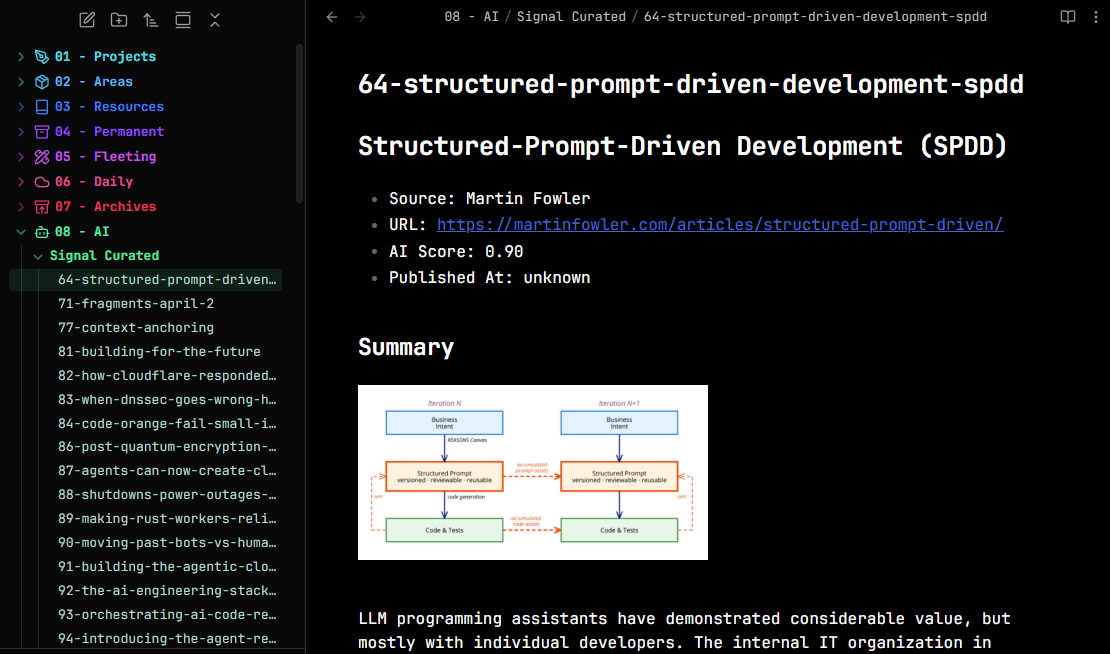
I already think in Obsidian - highlights, links, half-formed notes about Postgres or queues. Keepers that die in a web UI never get woven into that. Markdown in the vault does.
A cloud runtime cannot write OBSIDIAN_VAULT_PATH. That is the design, not a missing feature. The cloud owns ingest, scoring, health, retention, and export status. The local sync_obsidian script owns the filesystem write and marks status back in Postgres.
Curation state is the source of truth. The vault is a derived view of what you chose to keep. Scoring providers and markdown formatting can move; the queue and status contracts stay stable.
Cloud judges, laptop writes
RSS
Fetch feeds, normalize items, store new articles.
Scoring is LLM-assisted via Groq. The model is swappable; the persisted shape is what the rest of the system depends on. List articles with filters, read tags, curate deliberately. Feeds are operational entities - they degrade, disable, and reactivate - which matters more day to day than any single prompt.
Would this make the cut?
Guess keep or skip. Outcomes are fixed mocks, not live Groq.
1 / 4
eng-digest.example
A shallow roundup of headlines with almost no technical depth.
FastAPI on PostgreSQL (async SQLAlchemy + asyncpg, Alembic). APScheduler for fetch and cleanup. Groq for scoring. uv and pytest for the toolchain. Deploy is Railway-oriented; Obsidian sync stays local on purpose. Tests cover URL/hash behavior, feed health, scheduler runs, Obsidian writer/sync, and score parsing.
Fetch. Score. Curate. Sync. Less unread noise, more notes that stick.