Get in touch
Want to work on something together?
Just want to chat? Hit me up.
Wallbit already exposes the building blocks - balances, rates, wallets, trades, cards, fees. What I kept rebuilding was the glue: a key, two or three calls in order, some print statements, and an error path that meant whatever felt right that night.
Wallbit Workflows turns that glue into YAML you can validate, run, version, and share - plus the CLI, registry, and Go SDK that make the loop usable.
Day one is wallbit-cli:
go install github.com/jeremyjsx/wallbit-cli/cmd/wallbit@v0.2.0

wallbit auth login
wallbit balance checking
wallbit rates get --source USD --dest EUR
Auth stays ordinary (--api-key, WALLBIT_API_KEY, or wallbit auth login) so the interesting part can be the sequence of calls, not how the key gets smuggled into every script.
A workflow is a small contract: version: 1, a name, optional on_error, and ordered steps whose run ids map to Wallbit operations the CLI already knows.
version: 1
name: checking-then-fx
on_error: fail_fast
steps:
  - id: checking
    run: balance.get_checking
  - id: fx
    run: rates.get
    with:
      source: USD
      dest: EUR
wallbit workflow validate checking-then-fx.yaml
wallbit workflow run checking-then-fx.yamlSame shape every time. Reviewable in a PR. Rerunnable without archaeology.
Compose a tiny flow
Switch presets to validate. Same shape as wallbit workflow validate.
version: 1
name: checking-then-fx
on_error: fail_fast
steps:
  - id: checking
    run: balance.get_checking
  - id: fx
    run: rates.get
    with:
      source: USD
      dest: EUR
Steps
Valid · checking-then-fx
The before picture is hard-coded auth, a couple of HTTP calls, and exit codes that mean whatever you felt that night. The after picture is the file above plus two commands. Behavior is still the Wallbit API - the artifact changed. You can diff it, refuse a bad run id in review, and pull someone else’s flow without cloning their scripts/ folder.
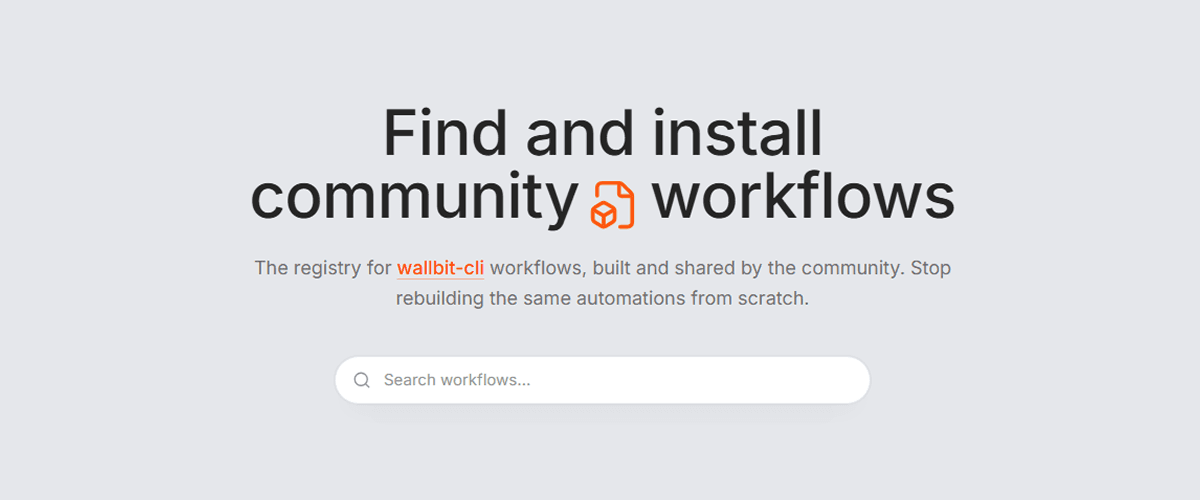
A useful flow stuck on one machine is still local. wallbit-registry is the public catalog: list, download YAML, publish immutable semver for author/slug. Duplicate version returns conflict. Pull is public; publish uses a separate registry key (wb_reg_… / wallbit registry login), not your Wallbit API key.
wallbit workflow pull author/slug@1.0.0 -o my-flow.yaml
wallbit workflow publish ./my-flow.yaml --version 1.0.0 --slug my-flow
Go HTTP API on Postgres, Next.js for catalog, install commands, account keys, and Workflow Studio. Studio authors YAML against the same rules the CLI validates - editor and runner stay aligned.
Browse → copy pull
Fixture catalog. No live registry calls.
YAML preview
version: 1
name: checking-then-fx
on_error: fail_fast
steps:
  - id: checking
    run: balance.get_checking
  - id: fx
    run: rates.get
    with:
      source: USD
      dest: EUR
Install
wallbit workflow pull jeremy/checking-then-fx@1.0.0 -o checking-then-fx.yamlwallbit-workflow-builder (skill + rules used by Studio) keeps generated YAML in the same dialect as wallbit workflow validate: same version: 1, same run catalog, same on_error / with / step-ref habits. Pretty editor and what actually runs share one contract.
YAML is for shared, rerunnable composition. Services still want a library. wallbit-go is the idiomatic SDK the CLI sits on: typed clients, context, structured errors, retries on safe methods.
client, err := wallbit.NewClient(os.Getenv("WALLBIT_API_KEY"))
balance, err := client.Balance.GetChecking(ctx)
Embed path for apps; YAML path for automations you want to pull and publish. Same API, different packaging.
| Piece | Job |
|---|---|
| wallbit-cli | Auth, account ops, workflow validate|run|pull|publish |
| wallbit-registry | Discover / version / pull / publish immutable YAML |
| wallbit-go | Go SDK; CLI built on it |
| wallbit-workflow-builder | Skill/rules (+ Studio) so authored YAML matches CLI validation |
Not a new finance API - a composition layer you can treat like software: a file, a command, a version, a pull.